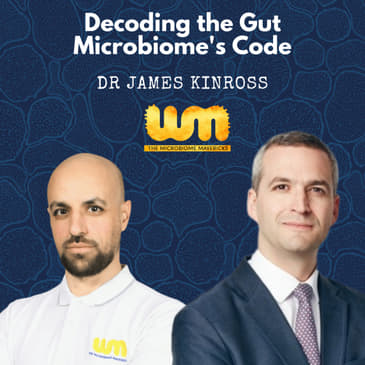
Hello and Welcome to the Microbiome Maverick Podcast, the only place where microbiome science meets real-world applications. I am your host Dr. Amine Zorgani, a microbiome expert on a mission to prevent the human microbiome from extinction!
In this captivating episode of the Microbiome Mavericks, we are joined by Dr. James Kinross, a renowned colorectal surgeon, author, and microbiome pioneer from Imperial College London. With a career spanning over two decades of groundbreaking research and clinical practice, Dr. Kinross delves into the profound impact of the microbiome on human health, particularly in the context of cancer. Through his engaging narrative, he takes us on a journey exploring the delicate relationship between our internal ecosystem and the onset of chronic diseases. Prepare to be inspired as Dr. Kinross shares his visionary perspectives on leveraging the microbiome for disease prevention, personalized therapies, and ultimately, transforming the future of healthcare.
Enjoy the episode, and please follow and share! Happy to hear your thoughts and stay positive!
You can find more about Dr James Kinross here: https://www.linkedin.com/in/jameskinross/
You can find more about The Microbiome Mavericks here: www.microbiomemavericks.com
If you are interested in speaking, partnering, or sponsoring the show you can reach out directly to dr.amine@microbiomemavericks.com
[00:00:00] Hello and welcome to the Microbiome Mavericks podcast.
[00:00:03] The only place where Microbiome Science meets real-world applications.
[00:00:08] I am your host, Dr. Amine Zorgani, a Microbiome expert on emission to prevent human microbiome from extension.
[00:00:16] In this episode of the Microbiome Mavericks we are joined by Dr. James Kinnos,
[00:00:21] a renewed, color-reactal surgeon, author, and a Microbiome pioneer from the Imperial College, London.
[00:00:29] With the career span in over two decades of groundbreaking research and clinical practice,
[00:00:34] Dr. Kinnos delves into the profound impact of the Microbiome and human health, particularly in the context of cancer.
[00:00:43] Through his engaging narrative he takes us on a journey exploring the delicate relationship between our internal ecosystems and the onset of chronic diseases.
[00:00:55] Prepare to be inspired as Dr. Kinnos shares his visionary perspective on leveraging the Microbiome from disease prevention,
[00:01:01] personalized therapies and ultimately transforming the future of healthcare.
[00:01:08] Enjoy the episode and please follow one share, happy to hear thoughts and stay positive.
[00:01:19] Thanks so much for joining us on the Microbiome Mavericks. It's really my pleasure.
[00:01:23] And actually I first came across your work when I was reading this Guardian News article, a readie for your Crap Soul.
[00:01:31] The word really amazed me, the Crap Soul, and I think he will explain a bit about it, which was,
[00:01:37] which was, Fickel Transplant could play a huge role in the future of medicine.
[00:01:41] And it was more about the Crap Soul, which is now obviously the Fickel Microbiota Transplantation and the Microbiome.
[00:01:49] So what can you tell us about the Microbiome? And more importantly, how did you end up into this field?
[00:01:55] Okay. Well, along with your questions in reverse order.
[00:01:58] So if you don't know me the thing that you should know is that I'm a color actal surgeon,
[00:02:02] so I specialize in the surgical treatment of cancer of the bowel.
[00:02:07] And I suppose started my journey into the Microbiome in around 2005 when I came to Imperial College of PhD,
[00:02:16] and I came to do that PhD with an open mind and no real preconceived ideas as to what I was going to study.
[00:02:22] And like all good things in life, my career has been greatly influenced by people,
[00:02:26] by the people that I met, and I just happened to meet some brilliant people.
[00:02:29] So I went to work for a guy called Jeremy Nicholson and his lab at Imperial.
[00:02:33] He was very interested in the Microbiome, and it's done a lot of the kind of early experiments in the Microbiome,
[00:02:38] and said, look, would you be interested in doing a PhD in surgery in the Microbiome?
[00:02:42] And I didn't know what he was talking about.
[00:02:44] I've been on stand any of his lines, and I kind of said, yeah, okay, I trusted you,
[00:02:48] and that's how my journey began.
[00:02:50] And like it's I suppose I call kind of early innovators and early adopters.
[00:02:55] It's been an interesting journey over the last 20 years also, because it's one of those scientists that was very much at the periphery.
[00:03:02] There was very much mistrusted that wasn't really taken seriously, and it's been very interesting to watch that come into the mainstream of modern science.
[00:03:12] And it's still not in the mainstream I don't think.
[00:03:15] It's only not in the mainstream of clinical science, and you'd be amazed when you go to clinical meeting clinical conferences
[00:03:21] that the Microbiome is still really a fringe concept of fringe theme, but I think it is changing.
[00:03:27] What is the Microbiome? Well, I think most of our listeners will have a really good understanding what the Microbiome is.
[00:03:33] But what I would say is that the Microbiome for me has a couple of core concepts, which are important to me at least when I conceptualise it.
[00:03:42] So of course, most people understand that it's a collection of all microscopic life forms and the molecules in environment
[00:03:49] that they need to sustain themselves within a niche, and you can define that niche by different scales.
[00:03:54] But for me, one of the key things that a Microbiome must have is some core evolutionary relationship with the host organism that it's residing on or in at some level.
[00:04:04] So that means there is some form of codependency.
[00:04:08] This is not a transient collection of microbes. This is something as a much deeper relationship.
[00:04:13] And you can conceive that evolutionary relationship over different timescales. You can conceive it over the time scale of a treatment, a lifespan or perhaps an epoch.
[00:04:23] And I think the second domain is time therefore. So time to me is extremely important in trying to conceptualise the Microbiome.
[00:04:31] And the third is that it's just highly individualised and highly personised.
[00:04:35] Yes, there are core functions that we will rely on and all depend on from our Microbiomes. But actually, we all have a slightly different relationship with our Microbiomes and they're really, they're really discreet and important.
[00:04:49] And for me, that's critical in what I do because it explains much of the individual variance that we see in treatment response, for example, disease risk.
[00:04:58] So that's kind of how I think about it and it's been really exciting to be part of the field for the time that I've been involved in it.
[00:05:06] Excellent. So you mentioned and trusting world here is that it is highly individualised and it's more like a finger print.
[00:05:12] So Microbiomes aren't all the same for different people. Probably within the same community or within the same household we may share similar microbes.
[00:05:22] Would that be a risk of delaying the fact that we're going from the lab to the bench side and going from this science that you said,
[00:05:32] from a clinical relevance today, there is still some gap from going to from the science to the actual applications.
[00:05:38] Yeah.
[00:05:40] So in your question, there's two or three really critical issues. So the first is that the Microbiomes that I'm particularly interested in,
[00:05:50] predominantly internal, so it's the gut really that I mean that's what I study.
[00:05:54] And of course the gut Microbiome exists in an environment that changes as soon as you look at it.
[00:06:02] So if you want to sample it or you want to study it, you buy definition change it and reconstituting and reconstructing it in a in vitra system more in a laboratory is very very difficult for that reason.
[00:06:14] The second thing is that you know we must not assume that we know who is there. There are still huge gaps on our knowledge of precisely what,
[00:06:22] you know, what type of organisms are the species or strain level are actually existing within these systems.
[00:06:28] And you know, we've got massive gaps in our understanding for example of the viral and precisely what they're doing.
[00:06:34] So we mustn't forget that when we're reconstituting these things even when we can do it, we may not necessarily be reconstituting the right,
[00:06:40] the right organisms. And the third is of course that the Microbiome influencers are risk of health and disease or treatment response over sometimes quite long time scale.
[00:06:50] So for in my condition that I study predominantly, which is cancer, that interaction may exist over a lifetime.
[00:06:56] And trying to re constitute that relationship over relevant time scales where you've got all the different components of that niche in one place at one time is really really difficult.
[00:07:06] And the final bit is that and this is quite fundamental is that Microbiome science by definition is studying the relationship,
[00:07:15] not just between organisms and the host. It's also studying the relationship between different members of that,
[00:07:23] of that consortium, different members of that network that interact together.
[00:07:27] And that's a very sophisticated and nuanced and subtle relationship.
[00:07:31] And the problem is, is that when you apply 19th or 20th century scientific or clinical rules for the disease definition, for example, they kind of fall down within that construct.
[00:07:42] And it forces us to reconceptualize some of the kind of fundamental conditions through which we make diagnoses of established clinical conditions
[00:07:51] and to rethink how those diseases are caused. So this is a kind of core concept that Microbiome scientists are really struggle with within the last 10 to 15 years
[00:08:01] because bench top experiments using mice, for example humanized mice, they're not really humanized mice Microbiomes.
[00:08:07] They're not, of course, they're not because they can't feed them a bucket of KFC and you can't study them over a period of 30th.
[00:08:15] And even when you can, we constitute Microbiome to announce the functions of those bacteria, for example, aren't necessarily representative of what's happening to human.
[00:08:24] And time and time again, mouse models that we commonly see published in high impact journals on the amount of the Microbiome don't stand up on the kind of clinical tests and they're not reproducible in humans.
[00:08:36] And therefore, for that reason we try and migrate anyway to study humans as much as we can because at least that way we've got you know representative ground truth.
[00:08:44] Now we're seeing solutions, you know, we are seeing evolution of, you know, a various approaches to solve those problems.
[00:08:52] So Microbiome and Hanscott and chips systems and you know, in silica models and sophisticated data and songs, we're going to solve those problems, but it's just taking us a while to get there.
[00:09:02] So I think again, as you mentioned, now the use of artificial intelligence and quantum computing will probably advance that we might go quicker.
[00:09:11] And simply because the complexity of the Microbiome is quite huge.
[00:09:15] And also touch based on that in your book, the Dark Meta where you basically mentioned the impact of high proglobalization and our addiction antibiotics or the enter ecosystems.
[00:09:26] And how would those influence the and shape our Microbiomes and obviously the interaction with disease that we might have right.
[00:09:33] So so this is I suppose this is a theme that I'm trying to communicate on on a number of different domains because you know, I think we have to just take a step back and have a slightly bigger picture.
[00:09:45] We of course have a planetary Microbiome right.
[00:09:48] And for me the way I think about this is really in terms of climate change.
[00:09:52] We have got a we've got a climate change that most people can conceptualize and understand and understand how animals with Instagram accounts are being affected by that and we understand how, you know, at risk communities are being affected by that.
[00:10:05] But we don't really think about its impact on Microbiome life forms and they are and their critical role in maintaining planetary health and by the same.
[00:10:15] By the same kind of concept we don't think about how climate change affects human health by changing the the health of Microgal ecosystems that we have relied on historically over evolutionary timescales to maintain our health.
[00:10:32] But try to unpick this is quite tricky because of course there are some some drivers that we can really understand that we can think about that kind of obvious so the globalization of our diet, the urbanization of our population saw the widespread adoption of antibiotic.
[00:10:45] But some of them are quite subtle and quite nuanced and and hard on pick and so you've got this sort of systems complexity and trying to explain that to one of my patients in my clinic about how they meaningfully use that information to reduce their disease risk got to improve the health then becomes a little bit harder our suppose.
[00:11:05] But so here when you look when you spoke about the complexity, you also mentioned a very interesting concept the internal climate crisis like what is happening inside.
[00:11:16] Can you a little bit expand on this idea of what doesn't mean this internal climate crisis that we might have do whatever probably is happening outside even.
[00:11:25] So so what I mean by that is that if you if you put the value of Microgal science in my opinion.
[00:11:35] Is that it allows us if we leverage it correctly to prevent disease right so the great bit of the Microgal science is that allows us to reconceptualize how a lot of the.
[00:11:49] Dramatic changes in our that have influenced and improved in many respects our quality of life through the industrial revolution.
[00:11:56] Have in turn led to a pandemic of chronic disease right and the best example of that would be obesity or card and metabolic disease which is actually the number one thing that's going to kill us at the moment the way we're going.
[00:12:08] But these sorts of diseases cross into a new mediator disease, chronic a new mediator diseases or allergies or things that don't kill us but severely affect our quality of life and transition into kind of mental health problems and got brain interactions right.
[00:12:21] So the Microgal biomancers to reconceptualize that and if you look at it in the from the perspective of the Microgal biom.
[00:12:27] Actually what you see is that the industrialization of things are antibiotic production and the misuse of antibiotics as antibiotics are a growth promoters in farming or the industrialized process of food manufacturing.
[00:12:43] Have happened at such an enormous scale but over such a rapid timeframe that our internal ecology has just not been able to keep up in fact it's been it's been destroyed it is being destroyed right and we and we know that because we can look at evolutionary Microgimes and look at how the Microgime changes over evolutionary timescales and we can see it disobeyring in the data it's going right.
[00:13:10] And of course antibiotics as a major driver for it but the farmer industry as a major driver for urbanization is a major driver for it.
[00:13:19] And these Microgimes are under a severe and unprecedented pressure by environmental pressure and they can't cope.
[00:13:28] One theory is that that is the reason therefore that we are seeing this rapid rise in this collection of chronic diseases these chronic.
[00:13:40] What will be typically conceived as non communicable diseases but actually have one thing in common which is a dysfunctional immune system which is no longer adequately maintained and produced and controlled by our Microgime.
[00:13:54] And just as sort of add one final point to that our Microgimes have a degree of pasticity they have a degree of resilience.
[00:14:02] Who kind of environmental drivers but there are emomates on our life when actually they're much more fragile than others and of course one of those is an early childhood.
[00:14:11] And one of the major theories that's coming out is not just that the maternal Microgime or the early life Microgime is.
[00:14:19] Is is very fragile and very susceptible to these changes but these things are generational that they are transferred from you know one generation to the next and there's a slower erosion and decay and is Microglie ecosystems.
[00:14:31] So we talk about microbial or cestral signaling right there these complex sort of symphony of molecular signaling languages that these Microgames speak well that the tune of the symphony is changing the tune is decaying the symphony is no longer playing a coherent song from mother to baby it's changing over is changing over time and these things are these things are quite worrying.
[00:14:52] So the good news is that if you conceive it through the Microgime you can start to find solutions you can start to explain why things are happening and you can start to leverage that to improve the situation either through innovation or through you know policy change.
[00:15:05] There is definitely a scary and optimistic at the same time because we understand that there isn't issue probably we might be able to decode it at some point but as you mentioned when we compare.
[00:15:15] We are trying to combine this isolated tribes like the hunter gatherers and people from California the latest study that was published recently in nature I think from Justin Sanamberg.
[00:15:27] It's just insane like I mean we lose in diversity compared to what they had but with this loss of diversity be one of the attributes or it's a promoters of development of cancer.
[00:15:41] Well, so I'm biased right and I have to like put up my hands right so I think it's a really big part of the story for sure.
[00:15:51] Now that doesn't mean that there aren't environmental cost in agents that cause cancer you know smoking causes cancer and has got nothing to do with the Microgime although actually it does it turns out right but you know it may like.
[00:16:03] You know cigarettes we're not going to get lung cancer and of course you know if you sit in UV light you're going to get skin cancers so.
[00:16:09] We have to be careful about how we phrase it but but 100% the Microgime is a key part of it we find bacteria within cancer cells we've we've long leverage the Microgime as a therapy for for the treatment of cancer and it's a and we have well established pathogens that that cause cancer such as HPV HPV virus.
[00:16:31] So yeah it's a 100% part of it but the thing that's I suppose challenging is is that most clinicians particularly oncologists don't conceptualize it that way they just that's not their fault.
[00:16:44] It's just not how they're taught it's not how they're educated and then what the brand doesn't sit as a tool within their therapeutic box and epidemiologists that haven't had the tools to really understand or to study the Microgime at scale across populations therefore it's just being this kind of.
[00:17:02] This black box it's just being this missing piece in the puzzle that hasn't really figured in in much of the in much of the you know the beat the big studies that come out a bit but just going back to your point and you mentioned just some of both study which is it which is a good study actually and I don't want to be.
[00:17:19] to kind of out it but what we really do need if the Microgime is to be successful is empowered.
[00:17:26] A global population of it empowered Microgime scientists that can do their own work on their own populations and what we have as Microgime science which is holy bias towards the US.
[00:17:37] Europe and China we don't have you know African researchers leading and delivering their own work and we really need to change that like we really do need.
[00:17:47] To ensure that we share the knowledge that we educate and we train and that we empower you know local people to look after their own local populations and to have control of those datasets and to ensure that they're empowered to leverage them to the maximum value.
[00:18:05] Excess because there is also an ethical part of it right so when you go and study the Microgimes of this kind of hunter gatherers or the animani or any other populations or in Africa.
[00:18:16] I mean these people they have the right to know that they have the right to either want you to publish or not their data and I think it's also from an ethical point of view it's very important and because you mentioned the African Microgime I think I take the chance here I had this question later but.
[00:18:34] You're also part of the African Microgime Institute honestly I didn't know that it was an African Microgime Institute simply because one day I was in one of the biggest European consortiums of the microbiomes like 24 or 25 countries and I remember one of them the panelists basically had projected.
[00:18:55] A map of where microbiomes studies are being conducted and Africa was black so I just randomly asked the question may ask why Africa is.
[00:19:06] Like colored in black he said yeah because there is no much research in there I said well done like you know.
[00:19:13] But can you tell us a little bit about what this African Microgime Institute is doing and what you're working there.
[00:19:18] So so look credit where credit's due that's really the work of a guy called Steve O'Keefe who's a long time collaborator of brilliant clinical scientists and gastroenterologists who.
[00:19:28] who is South African at trained in the UK and has actually worked in Pittsburgh as whole life and has gone back to the University of Cape Town to.
[00:19:40] To set up this this institution and you know it's it's an attempt to try and again create some leadership within within Africa to develop their own microbiome resource and to do their own.
[00:19:54] So we have a very good idea of the role the room microbiome science and and they're trying to secure it you know funding through the South African equivalent the NIHR I think to to do that work again we had a big initiative that kind of got badly hit by covid so a lot of that work got slow down by covid there is microbiome work been done in Africa there is quite a lot of microbiome work being done in Africa.
[00:20:16] It's just that I think it's much harder for those scientists to get their work out and to communicate it because a lot of the journals on the outputs of a bias towards US and European research so.
[00:20:27] There is a lot of work going out there and it's absolutely fascinating because of course it's not just human microbiomes that they're studying its soil.
[00:20:35] It's planetary it animals it's the whole shooting match and it and it's really really good quality work so yeah we.
[00:20:43] I first met Steve when we were doing some work together on a on a dietary intervention study looking at rural rural South African diets and comparing them to the diets of.
[00:20:56] African American men in North America and trying to establish how the microbiome influences cancer risk and that that was the kind of first of do we published in what's the published it used the first author in nature comes I think it was in 2015.
[00:21:10] And a lot of that work came on the back of that.
[00:21:13] Excellent because I think as you mentioned.
[00:21:16] African microbiome is quite interesting from different points of view I'm from Africa I'm from Algeria from the Mediterranean region right so and I can tell you that our diet is like in the Mediterranean region I mean speaking about.
[00:21:29] Algeria Tunisia Morocco Egypt.
[00:21:32] The diet is very different that would you would have in Europe or in the UK or in the US.
[00:21:38] How with where people do really take antibiotics without any medical prescription right so and I think they're really the straw in the microbiomes and one day I asked my mom on a recently ask her.
[00:21:49] What was the last time when you heard of someone that died naturally like no specific disease she said yeah I don't remember that's a long time ago simply because literally people everybody is dying from a specific disease whether that's being chronic or non chronic diseases.
[00:22:07] And I think this type of populations deserve to also have more research and conducting in there going back now to cancer because you're I take the chance because you're a collector expert and we spoke about this.
[00:22:22] And the role of microbiome in cancer and how probably is big part of the the unset of cancer what are the clinical practice today been done leveraging the microbiome as an entity you said that there are some clinicians that okay don't talk to me about the microbiomes probably there are others obviously like yourselves working on it so what are the approaches today being done or use to leverage the microbiome to prevent or more treat cancer because prevention is also I think in very important.
[00:22:51] I think in a video put on part of the question well I mean so I will answer question directly before I do just to make the point that you know what was seeing in in many.
[00:23:01] More rural communities in in Africa particularly is the is the urbanization of those populations and what we're seeing with it is a rising chronic disease so you're seeing the dual burden of disease and one hand you've got malnutrition poverty.
[00:23:16] And you know disease of deprivation on the other hand you've got a simultaneous rise in obesity rates and with that comes all of the kind of western diseases that you typically see including cancer.
[00:23:27] So what you're seeing is a global change in in colon cancer or colorettal cancer epidemiology and you're seeing a rise in these populations as their diet as their lifestyle becomes westernized.
[00:23:39] And therefore it's very important to understand that and to understand that through the lens of the microbiome because you can at least be able to communicate it in power people to stop to stop that change although it's incredibly hard of course because many of those things are outside of the control of scientists or health policy makers they're governed by fast food giants and.
[00:23:57] Yeah and capitalism. But so so what we are seeing in western populations particularly in colon cancer is a is an alarming rise in epidemiology or the risk of the incident as I should say, colon cancer and young people.
[00:24:10] So although we've got good national screening programs we are seeing rapid rises and people under the age of 50 and we don't know why if you're born in the 1990s your risk of rectal cancer or bowel cancer is four times that some of one in the 90s and 90s and 60s right.
[00:24:26] So the first application in your in your answer question is trying to understand the role of the microbiome in the etiology of diseases like cancer and and to understand why we're seeing this rapid change in the epidemiology of the disease and what role that plays because it's the middle man in all of the well established risk factors for these chronic diseases like diet right we've just got that.
[00:24:51] The second thing is really trying to leverage the microbiome as a biomarker so can you find a different way to leverage it to stratify risk and then to do something about it.
[00:25:02] The third is can you leverage the microbiome to to stratify therapy so a lot of this work has come out of groups such as long as zip the gels work or various other kind of groups around the work who've been looking at.
[00:25:15] Immunotherapy so the importance of the microbiome of regulating what's known as the tumour micro environment so in this collection is halo of immune important immune cells around cancer and it turns out that the microbiome is a really important regulator of how.
[00:25:30] These very very expensive immunotherapy's work and that you can fundamentally change their efficacy by FMTs a fecomargogotransplantation for example.
[00:25:41] But we're also seeing lots of work now trying to define how the microbiome changes the toxicity as well as the efficacy of more standard cytotoxid agents.
[00:25:53] And can you engineer it to make chemotherapy easier to consume and more effective but I suppose finally is can you mind the microbiome to identify novel therapeutic targets and novel treatment strategies in its own.
[00:26:08] And there's lots of exciting work going on at the moment in phage therapy and since end in synthetic biology so trying to engineer these these organisms to just not only deliver drugs into cancers that are hard to reach your heart to detect but actually to produce you know biological agents at the site of disease, you know can we can we program them in some way to be able to do that.
[00:26:29] So the microbiome because it's highly personalized because it's within cancers because it regulates immune response to cancers it's this hugely valuable and important therapeutic target but also it's a very important target for preventing this disease in the first place.
[00:26:47] So here there are also some aspects of somansaly ability of science from you mentioned that humanized animal models aren't probably the best to use because I mean it better to conduct clinical trials on humans.
[00:27:02] But one of the interesting points also I see is what we'll be able to predict the the possibility of someone to have in cancer, correct cancer or whatever because I would imagine like one of my dreams is that you would scan any food process product.
[00:27:19] The barcode of it and the app will count how many times you've eaten that thing and it will tell you listen you're increasing your chances of whatever types of diseases because today what we consume is basically is what we are and that's what shapes our microbiomes.
[00:27:34] How would you see today that the combinations between diets and microbiome to predict potential and set off cancer disease potentially for.
[00:27:46] Well, it's a really interesting idea and there's there's groups around the world trying to answer that question what what I would absolutely say with total confidence is that you cannot have a personalised or accurate cancer prediction model without the microbiome right so for the microbiome is so important that if you exclude it you're excluding a major both.
[00:28:10] You use me driver but also you know preventative component of your cancer is so you have to include it's a more complex thing to say well, how can we exclusively define risk by simply looking at microbiome environment interactions.
[00:28:26] I would argue you can get a pretty good model doing that but actually you've got to have some sort of host host biology built into that built into that conceptual model that you're trying to create and bigger and that's because of course the microbiome.
[00:28:40] influences cancerous through so many different routes it might be through epigenetic programming or it might be through some the metabolic derived you know immune dysfunctional son sort of you know somatic gene mutation so.
[00:28:51] It's it's because it's because it's so sophisticated it's a very very difficult thing to do now what you are seeing of course is lots of.
[00:29:01] work to look at sort of dark microbiome interactions for regulating specific nutritional outcomes or specific simple physiological measures like.
[00:29:10] I see me index or blood sugars. I think we will get the point where you can say okay yeah we can determine risk the question I would push back to is is when and how worldly can you do that can you do that at birth can you do it by you know puberty can you do it in your early 20s and and how accurate are those are those models and I think that's a very interesting question which we don't quite have the answer to.
[00:29:36] I think it's also probably in the future the more of let's say cases we have the more people we've screened like with this cohort like the French get project or the UK projects and so on will maybe able probably in the future to answer that.
[00:29:51] But let's pick that up because that's an important issue right so the problem is is that I would argue those databases are not going to do that and I would argue the reason not going to do it is because they're all suffering from selection bias number one.
[00:30:03] Yeah and rule middle class rich people right and actually they're not the cohorts most at risk and it's definitely is they're not measuring the right outcomes because they're not designed for cancer care so you can all you can build models which you know you could if you're lucky enough and you build a database right you can link to national cancer registries or you might be able to you might be able to you know derive some sort of market but they're not actually precise enough of what you really need.
[00:30:27] And also you know there's huge variation in the way those databases are samples and which but I'm trying to study and like they're fraught with problems and we've so much in the last 20 years.
[00:30:39] And actually I would argue that what you really need is is a properly designed studies that are really targeting vulnerable vulnerable members of our society or the most vulnerable members of our society.
[00:30:53] which are funded in a way that they are properly inclusive and designed to reach those members of society and that they're actually measuring the right clinical outcome measures.
[00:31:02] All the right environmental drivers in an accurate way and they're not actually just rather.
[00:31:08] In covers for commercial activities which is actually just designed to try and mine all of these things for profit right that we've gone we've got to have trust in the microbiome science you got to have trust and if you don't have that trust what will happen is that no one will really commit to it so.
[00:31:24] I don't know I I remain I think they're useful discovery data that's but I don't think there are a bust enough for doing the kind of precise level of oncology kind of research that we really need.
[00:31:36] You definitely convinced me and I really hope you get a funding to actually do your dream.
[00:31:40] I try it because you see us to like to have one right.
[00:31:43] Yeah that's all we want you're a big global studies right but they have to be longer tuned on and remind in my opinion they've got to go from birth to death right so you've really got to get these guys these studies like trying to.
[00:31:57] You know I think for non nutrition and dietary studies what we learned was that actually if your nutritional intervention is significant enough you can really change the function of the microbiome pretty quick within a couple of weeks but actually changing the structure the microbiome is really hard like because once it's in its adult construct is pretty fix like trying to move it pretty difficult now I'm a surgeon.
[00:32:17] I physically cut it out so that's quite exactly but the most people is quite hard so so actually what you really got it if you're going to build those data say really got to look at those moments in life where there's a lot of.
[00:32:29] There's a lot of instability in the microbiome which means you've got to be looking at the maternal and the early microbiome development and you've got to be looking you know later life when when when you get that kind of instability and and to me I'm absolutely convinced about that so we've got you know we're very lucky we've got two cohorts of.
[00:32:46] longer tunal cohorts of neonates both term and pre term that we've been following now for about eight or nine years and when you start to get that longer tunal picture out and you start to see these kids go through their major developmental stages that's when that's where the real.
[00:33:02] I think that's where the much of the future microbiome science is going to focus.
[00:33:08] Excellent and also you mentioned about how quick the microbiome changes is definitely there is question I think one day one of my colleagues told me once they sample like when I look into diet then first of title the microbiome.
[00:33:21] I said don't miss Fridays and Mondays obviously Fridays that exhausted that are going to the weekend they will do a party and don't miss Monday they're probably their hangout so their microbiome is already chilling so maybe you should look into that.
[00:33:36] There are probably also some cancer patients that are listening to us now and what would you tell them if these cancer patients their doctor has never told them about the microbiome so.
[00:33:48] Would they should be concerned.
[00:33:50] Well look just coming back to your last point like the microbiome oscillates right so it oscillates with our life cycle and with our life stage but it oscillates and vibrates on an hourly by daily is kind of very you know skeleton.
[00:34:04] There's been nice studies looking at things like sleep cycles looking at menstrual cycles looking at you know and these things vary between they vary between sex as they vary between ages and again they're really personal so when you're talking about the timing actually it's super important like you know the microbiome of a shift workers very different from the microbiome of the day work right and that's because you know for this lot of reasons why there.
[00:34:26] So to come back to your question, what would I tell a cancer patient is that I would say that you should.
[00:34:39] Think about trying to protect your microbiome through cancer treatment as much as you can so what I mean by that is first of all take a diet really seriously.
[00:34:50] And the nutrition and dietary support that you need will vary very much depending on the type of cancer you have the type of treatment that you're receiving and the treatment objectives and goals that you've got.
[00:34:59] But generally and broadly speaking, you know really excluding junk food the sort of food that you typically eat as comfort food when you're sick like busy drinks chocolate.
[00:35:10] That's just gotta go we know that that's really not good for your microbiome and it really does change you know treatment efficacy in response.
[00:35:19] Really try and avoid antibiotic consumption unless there's good evidence for its use right so unless your clinician is saying to you look.
[00:35:28] You really need to have this antibiotic because you're at risk of its sex or because you know you've got a proven and established mode of infection you know don't don't fall back on them as easy.
[00:35:37] Treatment or easy get out of jail, you know treatments because you know that they don't work which means that you've really got to make sure that you're vaccinated.
[00:35:44] All right, so please take your vaccinations it's really important and that you you know do your best to be sensible and to protect yourself from pathogens as best you can because the dangerous there's as much problem in the antibiotic as there is in the in the in the in the in the in the pathogen.
[00:36:02] It's I'll be the second thing the third thing is is that actually coming back to our previous points.
[00:36:08] The things you know that you do that perhaps were previously considered integrative therapies or perhaps maybe a little bit out of you know mainstream clinical therapy or actually quite beneficial for your microbiome so staying active staying social sleeping well.
[00:36:27] And you know these things do regulate your microbiome they do have they do they do play role in your therapy and they're important they're important to do and I've become much more open minded to them as a clinician as I've got a lot.
[00:36:41] I used to be very dismissive and as clinicians we worry a lot because the word these studies lot is interventions don't have trials data support them so it's very difficult if you're a frontline clinician say yep, you know have this particularly nutrition intervention but actually I think I'm now I'm now quite.
[00:36:56] I'm now quite quite supportive of my patients when they when they want to have these treatments.
[00:37:00] I'm very pleased as well as a scientist working on the microbiome from let's say from the lab point of view.
[00:37:06] To see also clinician that is also convinced of the importance of the microbiome to the point he wrote a book again I mentioned the dark matter what you will be tell us like to and this conversation for our readers about this book and I mean what what makes you to write it in the first place.
[00:37:25] So for me this was like a this was an attempt to try and explain to people why I think the microbiome.
[00:37:36] Is the future of of modern medicine really of of protecting and promoting our health and it is an attempt to try and do something that no other book that I had read had done which is to try and bring all these diverse strands of microbiome research into one place and to critically.
[00:37:54] And to critically here in argument that says look we've got to reconsider how we think about human health and do that at a very philosophical in a philosophical way but also to do that in a very practical way.
[00:38:08] So this book talks about it's a book and three parts the first book is really the science of the microbiome how it evolves with us how we've established the deep evolutionary links with it how it maintains our health.
[00:38:19] Our maintains our aging process how sex symptoms as a microbiome and why we get disease and what happens when it goes wrong.
[00:38:26] The second part is a book really about our environment or what we call the exposure so it's a book about what we were talking about earlier exposure microbiome interactions.
[00:38:34] How the world around us shapes our microbiome and why that's really important leads this argument of hey there's a climate crisis as an internal climate crisis because these things are going wrong.
[00:38:44] The third part is okay well what's next what's the future where are we going how do we earn this stuff into stuff that's really meaningful now I know a lot of your listeners will probably be interested in microbiome startups and microbiome.
[00:38:56] You know sexy microbiome biology and engineering and this kind of crazy stuff and it is a pokepunkers and I do love it and we do.
[00:39:03] But actually this book in it it's hard it's a policy book.
[00:39:07] It's a book that says to people that are making healthcare policy look if you want to have a healthy aging population if you want to change declining global
[00:39:15] Infertility rates if you want to stop this awful burden of chronic disease that is predominantly affecting the very young and the very old you've got to change strategy and and you have to include the microbiome in your healthcare policy otherwise you will fail.
[00:39:30] And and that's really what it's saying and it's trying to give an argument for how you could create different different different vision of delivering healthcare to do it.
[00:39:39] And and you know like all good books it was.
[00:39:43] It was something just you know I I felt like it was it was time to write so that's why wrote it.
[00:39:49] Congratulations really and I'm really pleased as well to hear that.
[00:39:53] Definitely so if you're interested into the book and you should be interested because that's exactly what we're saying here.
[00:39:59] I have a look into James's website which I will put a later on on the bio James we've literally end up into our conversation was just coordinating.
[00:40:10] But I would really like to share the last five questions that I asked all microbiome ever.
[00:40:16] And you've already probably touched on based on it. Why do you do what you do.
[00:40:25] This is going to sound corny but I do it because I want to make a difference because I believe that I believe that the microbiome really can improve people's lives.
[00:40:36] And I believe it's accessible to everybody and I believe that this can be low cost globally accessible.
[00:40:44] You know therapy that can that can really meaningfully prevent the misery of chronic disease for lots of people and you know I spend my day treating cancer.
[00:40:52] And this is a preventable disease in the majority of cases and so that's why I do it really.
[00:40:58] Amazing.
[00:40:59] I never thought about this low cost prevention method literally because when you speak about cancer and immunotherapy is there's just like cost fortunes right.
[00:41:08] While here if you've been if you've prevented just by probably changing your diet or maybe just practice in sport or sleeping better.
[00:41:15] It's just amazing.
[00:41:17] So look like if you know if you don't need a fancy, you know, personalist nutrition therapy to reduce your cancer disease risk you just need to eat more fiber.
[00:41:28] This is the thing that does my head is like you just need to eat more fiber and the microbiome explains a large part of why that fiber works.
[00:41:35] That's the gift of the microbiome but the health prevention strategy is there and it's cheap and everybody can do it.
[00:41:43] The challenges you've got to change human behavior you've got to do sway to people, but these unhealthy foods which are tasty and delicious which also quite cheap are really not as good an option as this fiber so for me that's the gift of the microbiome is that how do you really leverage this to improve population health.
[00:42:00] How do you do it at scale? How do you do things that are really transformative and I believe in the microbiome is one of the few sciences that you can do that in the way something like genomics.
[00:42:11] Exactly. Can you share one predicted tip that would help probably someone?
[00:42:17] Sorry one predicted tip.
[00:42:20] Productivity tip.
[00:42:24] I'm going to suggest you something that I don't do, but I wish I could do, right? So my, I don't this is not what I do, but it's what I wish I could do. So my one productivity tip to do one thing at a time and do it well.
[00:42:39] I live in a world of many, it's fitting plates and I wish I could just live in a world with one plate and I could just focus all of my energy and really deliver it well.
[00:42:48] But that would be my top tip.
[00:42:50] I mean, I would imagine how if you would do one thing at what at a time what would the outcome be because today you're just fascinating so.
[00:42:59] Yeah, I don't know, but you know that's so my gift is my dyslexia and that's on my brain.
[00:43:06] But like I think if I could reprogram myself, I would just do one thing at a time.
[00:43:10] I'm pretty sure.
[00:43:11] Do you have one book that you'd recommend it to someone?
[00:43:14] Yeah, I totally do. I've just read it actually. So it's a kind of contemporary book.
[00:43:18] So I recommend you Rick Rubin's book that's recently come out called the Creative Act.
[00:43:23] And if you're a scientist, I really would recommend it to you.
[00:43:27] I have a very diverse career. One of the things that I happen to do is I'm a co-director on a healthcare design modular imperial college.
[00:43:35] So we take artists and scientists. We put them in the room together and we ask them to solve problems.
[00:43:40] I think I think you know there's a good quote in that book which says that science eventually catches up with art.
[00:43:46] Like I think I think creative thinking is a very undervalued resource in science.
[00:43:54] This idea that you can think very differently around a problem and that you can be comfortable being a bit different in the room for the other people that all think the same way is an important thing.
[00:44:03] So I'd encourage that book. It's a bit, don't get me wrong. He's a bit left field. There's a bit of you know it's some slightly.
[00:44:10] I can't be thinking there but I kind of liked it and I found it refreshing. Thank you. Can you tell us about someone who inspires you?
[00:44:22] So so I'm inspired by my patients every day.
[00:44:26] I'm going to say that. It's a bit, you know, it's a bit of a cop out because it's not one person but I do meet incredible people every day.
[00:44:34] I suppose the great joy of my job is that I see people at their very worst but I also see people at their very, very best.
[00:44:42] You know and seeing these you know my patients who are just incredibly stowacall and wise and is always inspiring and you know I'm feel very privileged to be able to do what I do.
[00:44:56] So I would say my patients whoever my patient is today is who I'm inspired by most.
[00:45:02] I'm jealous. If you would like to help to change one thing on this planet, what would that be?
[00:45:08] Oh God. There are a number of politicians I would put in the space rockets and spend centre the moon. There are a large number of them.
[00:45:17] I would like to reverse Brexit. I would like to, I would like to make the world a fairer place but I think, you know the most pressing thing at the moment now if I could change one thing would be to reverse climate change I think that would be important for us.
[00:45:29] Excellent. Thank you so much Dr James. It was really truly pleasure to speak with you and get inspired by the world of doing and the lives you're changing with the relations through the microbiome and treatment against yourself. Thank you so much.
[00:45:43] Hey, pleasure absolutely all mine. Thanks so much for having me.
[00:45:47] Thank you.